When investing in emerging software markets, it is difficult to make a lot of money unless you own one of the top three companies in a particular segment. One simple reason is that there are usually not more than three or four meaningful public players that would have an interest in and be in position to acquire you. The “strategic acquisition” binge in the market typically happens quickly and then the universe of would-be acquirers moves on. As a result, it is very important to be in a position to be visible to would-be acquirers.
It is typical in an emerging market for technology providers to show confusing signals to the acquiring community. In most instances the early-stage emerging market will demonstrate market parity among solutions providers making one indistinguishable from the other. Why does this happen? The regular explanation is that customers in early-stage emerging markets have not, on average, had enough time to think about the broad scope of their new initiatives. What this means is that they regularly put out RFPs for technology that reflect narrow and immature ways of thinking. In this context, products whose functionality is narrow but can fit the market’s currently narrow needs are highly competitive. These products can also be sold for less as they require less payroll to develop given their narrower scope. Which product would you rather buy….? …The one that does what I think I need today and costs a heck of a lot less than the other one. We see this all the time. This is why so many technology providers can plausibly declare victory early on (and most try to).
So in the early-stages of an emerging market…many companies can favorably and equally answer the question..“Who is you customer?” They can do so because of narrow scope issues explained above and the fact that software price is still a heavy consideration to buyers. At this time…it is too early to sell or even try and sell you company- generally because price competition among solution providers is still too relevant.
Price competition is still a factor because... .there is an undereveloped connection. The scope of the average RFP (usually drafted by operations personnel) is much narrower than the vision of company’s senior management (i.e. this is the underdeveloped connection). At a time when the RFP more thoroughly includes senior management’s vision, price ceases to work well among competing software vendors and thereafter technology leaders start to emerge. Something about the technology then comes into play in the acquisition price (i.e. ease of implementation, adoptability, etc). It is not much longer after this that companies get bought. In my opinion if you go more than 18 months where price is the competitive driver, you are in a bad space for any number of reasons.
Monday, March 6


Friday, February 24
What's Wrong With This Picture?
A Short History of the Film Processing Industry
HP intends to package its at-home technology into a commercial-grade offering. The practical implications are that retail film processing is going to become real-time and pervasive (closer to wherever the consumer happens to be). More specifically, processing in real-time means that a consumer doesn’t have to contemplate a return visit when mapping where to have film developed. In addition, HP’s small-footprint technology can physically go just about anywhere. It simply needs power and a phone line in order to bill your credit card. This will be a “Highly Distributed” network that can process content in Real-Time.
A Basic Observation of Networks
So let’s observe what is going on here. Technology advancement enables certain types of networks to cost-effectively increase the number of end points along the network edge. So as things get more efficient and economical they have a tendency to proliferate along the edge – the network can become more populous and reflect greater geographic distribution. It is all based on cost effectiveness – nothing else. This happened with computers, movie distribution, ATMs, TV’s, IP vs. Frame-relay networks and is the story for so many other technology evolutions. This basic law of network physics repeats itself over and over again.
Evolution of Photo Processing Networks
---- Network Design-----Technology Attributes--------Primary Business Model Factor
#1 Hub and Spoke------ Largest, Most Expensive------Basic Service
#2 Distributed---------- Smaller, Less Expensive-------Preferred location, Time Convenience
#3 Highly Distributed--Smallest, Least Expensive----Ubiquity and Greater Time Convenience
Back to Metaphor Building
So what if the photo processing technology had never evolved from the early days but consumers insisted on having film processed when and where they wanted it? Cost would go up astronomically. Perhaps this would be OK if the associated costs could be passed on to family members who wanted to see photos at any price. But what if they didn’t and still wanted photos processed when and where they wanted?
Applying Network Evolution Observations to Energy
To use a meticulously fabricated metaphor, oil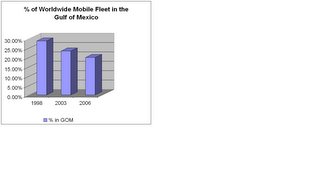 companies are changing the locations where they want their photos developed. Oil companies are uniformly moving into more-remote locations and thus the exploration and development network has jumped to a more Highly Distributed state. As some proof of this - the graph to the right reflects the decrease in concentration of the worldwide mobile rigfleet away from the Gulf of Mexico over the past six years. What one can't see is that the rigfleet also seems to be moving around faster and faster. If all this is true it prompts me to wonder….…….”What technology advances per se can we observe that have enabled this network to change its distributed state?" Answer…none really (thus far)...not in a network management sense.
At Some Point Between Now and the End of Time
The cost of labor, drilling rights, rig rental, etc. is going to continue to go up which can decrease fundamental profitability of the industry. As this happens….this extremely cost-conscious hydrocarbon seeking animal will look at the state of its geographically expanded network topography with greater cost consideration - old photo processing technology will be anywhere and everywhere…put there because consumers insisted on having film processed when and where they wanted.
The oil industry’s manufacturing network is at its farthest possible geographic edge. It is now time to backtrack and call in “HP” to provide technology advances to make this physical change in network state adhere to our observed laws of networks. To develop a means by which the required changes in network layout are supported by cost effective management advances rather than an ability to pass through all costs to consumers. Commodity businesses simply are not stable enough to rely on pass-through-longevity. In the way that oil prices spiked during 2005 as a result of force majeure, what if they moved at the same speed and force in the opposite direction? Can the current cost structure of the current network state support such a change? One could make the case that the rope could be drawn very tightly very quickly and, all other things held equal, it would tear dramatically. If you think about it...this has very specific investment implications.
A Side Note I Couldn’t Fit Anywhere Else
At the February 2006 Society of Petroleum Engineers Bytes and Barrels conference in Houston, Texas I heard three main categories of observation and complaint: (i) how do we get more data on a real-time basis; (ii) how do we organize the data for future use once today’s need has passed; and, (iii) how do we get corporate structure and people to change in such a way as to make the availability of data a useful thing.
Network Design #1 - It used to be that strip mall architecture included a small drive-thru booth in the parking lot. The business purpose of these drive-thru booths was to gather photographic film from consumers and distribute photos back to them - usually in about three days. Film booths were located in strip malls due to their proximity to consumer traffic. Film was gathered and then delivered to a central location which housed processing equipment that was large, technical, and complicated to maintain. This system of gathering, processing and distributing was essentially a “Hub and Spoke” network. The network processed content slowly.
Network Design #2 - During the mid- to late-eighties, film processing became the domain of the one-hour processor. One-hour processing came into being partially because of advances in technology - processing equipment became smaller and easier to operate and maintain. These machines were smaller than their predecessors and cost-effective enough to greatly increase the number of locations where they could reside profitably. Their positioning correlated to retail establishments of frequent, recurring consumer traffic (e.g. grocery stores, drug stores, Wal-mart, etc.). For some consumers, the attraction was speed of service. For others, it was the convenience of geographic proximity to their daily routine. This was conceived as a “Distributed” network that processed content nearly Real-Time.
Network Design #3 - The other day, I read an article in the Wall Street Journal regarding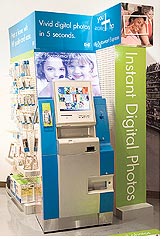 Hewlett Packard’s (“HP”) new strategy for digital photography. HP previously focused on at-home photo processing….a focus which has not met company expectations. The reasons are (i) the variable cost per picture is a little high; and (ii) the cost for a commercial quality printer is still significant.
Network Design #2 - During the mid- to late-eighties, film processing became the domain of the one-hour processor. One-hour processing came into being partially because of advances in technology - processing equipment became smaller and easier to operate and maintain. These machines were smaller than their predecessors and cost-effective enough to greatly increase the number of locations where they could reside profitably. Their positioning correlated to retail establishments of frequent, recurring consumer traffic (e.g. grocery stores, drug stores, Wal-mart, etc.). For some consumers, the attraction was speed of service. For others, it was the convenience of geographic proximity to their daily routine. This was conceived as a “Distributed” network that processed content nearly Real-Time.
Network Design #3 - The other day, I read an article in the Wall Street Journal regarding
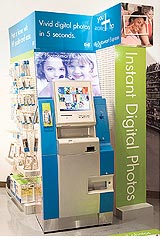 Hewlett Packard’s (“HP”) new strategy for digital photography. HP previously focused on at-home photo processing….a focus which has not met company expectations. The reasons are (i) the variable cost per picture is a little high; and (ii) the cost for a commercial quality printer is still significant.
HP intends to package its at-home technology into a commercial-grade offering. The practical implications are that retail film processing is going to become real-time and pervasive (closer to wherever the consumer happens to be). More specifically, processing in real-time means that a consumer doesn’t have to contemplate a return visit when mapping where to have film developed. In addition, HP’s small-footprint technology can physically go just about anywhere. It simply needs power and a phone line in order to bill your credit card. This will be a “Highly Distributed” network that can process content in Real-Time.
A Basic Observation of Networks
So let’s observe what is going on here. Technology advancement enables certain types of networks to cost-effectively increase the number of end points along the network edge. So as things get more efficient and economical they have a tendency to proliferate along the edge – the network can become more populous and reflect greater geographic distribution. It is all based on cost effectiveness – nothing else. This happened with computers, movie distribution, ATMs, TV’s, IP vs. Frame-relay networks and is the story for so many other technology evolutions. This basic law of network physics repeats itself over and over again.
Evolution of Photo Processing Networks
---- Network Design-----Technology Attributes--------Primary Business Model Factor
#1 Hub and Spoke------ Largest, Most Expensive------Basic Service
#2 Distributed---------- Smaller, Less Expensive-------Preferred location, Time Convenience
#3 Highly Distributed--Smallest, Least Expensive----Ubiquity and Greater Time Convenience
Back to Metaphor Building
So what if the photo processing technology had never evolved from the early days but consumers insisted on having film processed when and where they wanted it? Cost would go up astronomically. Perhaps this would be OK if the associated costs could be passed on to family members who wanted to see photos at any price. But what if they didn’t and still wanted photos processed when and where they wanted?
Applying Network Evolution Observations to Energy
To use a meticulously fabricated metaphor, oil
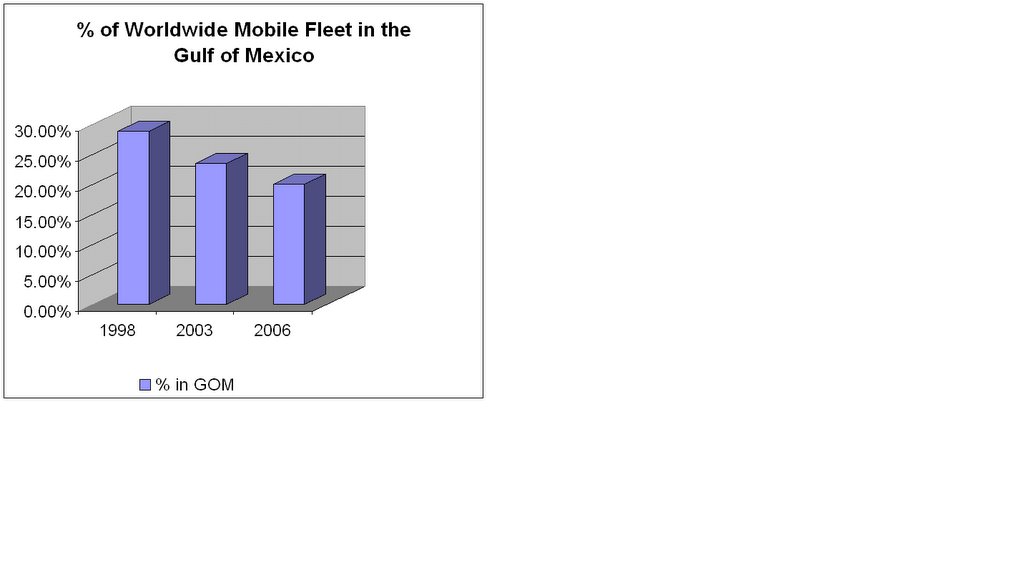 companies are changing the locations where they want their photos developed. Oil companies are uniformly moving into more-remote locations and thus the exploration and development network has jumped to a more Highly Distributed state. As some proof of this - the graph to the right reflects the decrease in concentration of the worldwide mobile rigfleet away from the Gulf of Mexico over the past six years. What one can't see is that the rigfleet also seems to be moving around faster and faster. If all this is true it prompts me to wonder….…….”What technology advances per se can we observe that have enabled this network to change its distributed state?" Answer…none really (thus far)...not in a network management sense.
At Some Point Between Now and the End of Time
The cost of labor, drilling rights, rig rental, etc. is going to continue to go up which can decrease fundamental profitability of the industry. As this happens….this extremely cost-conscious hydrocarbon seeking animal will look at the state of its geographically expanded network topography with greater cost consideration - old photo processing technology will be anywhere and everywhere…put there because consumers insisted on having film processed when and where they wanted.
The oil industry’s manufacturing network is at its farthest possible geographic edge. It is now time to backtrack and call in “HP” to provide technology advances to make this physical change in network state adhere to our observed laws of networks. To develop a means by which the required changes in network layout are supported by cost effective management advances rather than an ability to pass through all costs to consumers. Commodity businesses simply are not stable enough to rely on pass-through-longevity. In the way that oil prices spiked during 2005 as a result of force majeure, what if they moved at the same speed and force in the opposite direction? Can the current cost structure of the current network state support such a change? One could make the case that the rope could be drawn very tightly very quickly and, all other things held equal, it would tear dramatically. If you think about it...this has very specific investment implications.
A Side Note I Couldn’t Fit Anywhere Else
At the February 2006 Society of Petroleum Engineers Bytes and Barrels conference in Houston, Texas I heard three main categories of observation and complaint: (i) how do we get more data on a real-time basis; (ii) how do we organize the data for future use once today’s need has passed; and, (iii) how do we get corporate structure and people to change in such a way as to make the availability of data a useful thing.
Subscribe to:
Posts (Atom)

