Wednesday, September 20

The Unforeseen $2.3 Billion Phone Bill

Within our investing activities, we look very closely at data networking technologies, data networking devices, and the cost of energy. We also look at energy efficiency.

In observing energy usage patterns, we have learned that the more energy efficient we humans become, the greater our demand for energy. An example of this is mankind's improvement in various battery technologies and microprocessors. Batteries have become more capable of delivering power over longer periods of time...and microprocessors more capable of using less power during that period.....this is why I can walk around with a handheld computer that doubles as a cell phone with four hours of continuous usage (this is a form of becoming more efficient).

A couple of quick facts -
There are currently 219 million cell phones in the US and the average cell phone uses about 9 kilowatt hours of electricity per year.

Several years ago I went to see the Hoover Dam. The stories of its construction, how it works, and what it does are a mind bender. So I started to wonder...How much power consumption does the country's population of cell phones consume as denominated in number of Hoover Dams required to power that population? Based on a couple of different approaches, I estimate that about 60% of Hoover Dam's power output is used to keep our cell phones up and running on a continuous basis. Interesting...
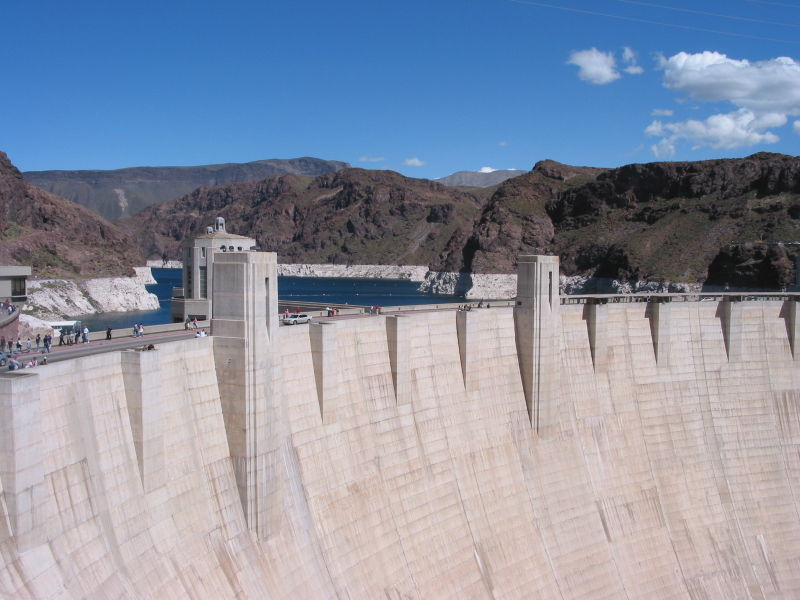


The cost-to-complete Hoover Dam in 1936 was $165 million or $2.3 billion in today's dollars. Hold that thought. Now think about the different number of devices that have been introduced to us over the past several years that consume electricty. Here is a brief list of things you may have added to your home over the past three years: iPod, Internet-enabled Cellphone, DSL/Cable Modem, Wireless Networking Access Point, Tivo Box, iPod Basestation Jambox, Portable DVD Player, Some GPS device, Home Theater Accessories, XM Radio Receiver.

Lets just assume for a moment that each of these 10 devices had the same popularity and power consumption needs as the cell phone above. This assumption implies that we would require 6 Hoover Dam-power-generating-equivalents to keep these devices up and running. Last I checked, the number of Hoover Dams going up every year is not keeping pace with what my imagination tells me is the increased electrical demand of these little power-hungry rodents.

Now lets turn away from the consumer market and think about industry. The increased use of internet protocol as a networking scheme combined with improved computer chip design and software design is causing the number of commercial and industrial edge devices to go nuts. Five years from now we are going to be monitoring and connecting everything to and from everywhere. Your iPod is sort of an example of the first step toward this end - better networking technology, good software design, all on a tiny little thing that can plug into the network from anywhere.

If I go back to my analysis of Hoover Dam and the $2.3 billion (in 2005 dollars) cost-to-complete, I then estimate that it requires $6.50 of investment to create power generation infrastructure capable of powering one cell phone (yes...this is all a little loose). I then start multiplying this by the number of little devices that exist in my consumer life and I wonder who is going to put the money up to build the power generation capability to support my new high-tech electronic lifestyle. Then I realize.....ME. It is going to come in higher rates over a sustained period because the planning, permitting and labor required to build more power producing infrastructure is going to take years and years and will be chasing an ever increasing target.

Then it hits me. I have got to invest in things that make for more efficient use of power so I can lower my overall usage. I then realize that the more efficient I become using power (like those batteries and microprocessors referred to above), the more alternative uses I can find for power (like my iPod) and the more power I will demand pushing the prices back up. I can't stop shopping at Best Buy.


How do I get off of this ride?


Friday, September 8

No One Starts Out Wanting to Provide Bad Service.


Most people on the planet have a shared set of physical, intellectual and emotional needs. These needs are identical at the “physical” level (i.e. food, water) and similar at the “emotional” level (i.e. security, acknowledgment, etc.). We humans fulfill our physical and emotional needs in many different ways and at different times. We physically labor to meet the physical requirements of survival…to earn money to buy food and drink. The time commitment required to labor during the work week to meet our physical needs is not inconsequential. You know this. We generally spend much more time conscious with our co-workers than we do conscious with our loved ones. The emotional needs of the humans do not pause between the hours of 9:00am and 5:00pm….as a result we need and seek emotional and intellectual fulfillment during our physical work hours.

The emotional needs of the American enterprise are as genetically similar across organizations as they are among humans - corporations consist of humans. It is arguable that most of us like praise and will work for it. We want to do good and we want to be good. These are atomic-level truths.

As a result, I believe that we manifest our individual work tasks and environments to provide for emotional aspects of our very human needs. Since these atomic-level aspects are bouncing around in the organizational consciousness…and organizations are collections of people…how is it that some organizations just end up providing bad service (which is a perfect mechanism for acknowledgment and thus emotional fulfillment). Now certainly these organizations don’t start out intending to provide bad service… they don’t sit down in the Board room and declare [bad service] as a strategy…furthermore most organizations would deny their possible inclusion in the list of bad service providers…yet….we see it and live it every day.


Bad Service and the Proprietary Network

I have seen the connection between the evolution of bad service and the proprietary network too many times to not comment on it. OK…what am I saying?? Many times, when there is a technology shift the new form of technology either becomes open standard or proprietary. In the instance where the technology becomes proprietary, the customer develops a weird sort of dependence on the technology. As this relationship lengthens it is, in my experience, not atypical for the technology or technology-based service provider to convert to a cash harvesting mode reducing development in research and development.

What then happens is that a newer, potentially-displacing technology develops and the market begins to see new things and want new things from incumbent service providers. The process has a tendency to creep slowly in most instances. The incumbent though has built a revenue model and compensation scheme that would be put at severe risk if the newer technology were adopted wholesale by the incumbent. Since the underlying technology doesn’t evolve, the incumbent becomes unable or unwilling to meet product development requests whose origin derives from the attributes of newer technology (i.e. I wish your product could do this or that or the other). After awhile, employees of the incumbent service provider become overly proficient at repeating the word “no” to customers. When lack of R&D investment forces the customer-facing employees to repeat the word “no” excessively…those customer-facing employees no longer get to see smiles and hear words of congratulations from customers. In other words, they lose the ability to get their daily affirmation from the market, the acknowledgment they want and thus the emotional fulfillment they need. After a while people that can’t get what they need develop bad attitudes…I know I do. Then comes the bad service.

A Specific Example

I know of a company that provides mission critical data services. This data has historically been provided over a proprietary network. The data provider would come in and sell its equipment and servers, etc. as infrastructure over which to deliver the data. Initially this is what the market wanted and customers loved it. The company was nearly the only game in town and it made a ton of money. Its compensation structure revolved around proprietary data transport mechanisms. The problem was it made too much money off of the transport to want to change…life was good and they were getting fat.

Along came the Internet.. a cheap way of getting data from point A to point B. This open transport standard allowed new things to be done with data..these are new things that customers started to think about and request of incumbent service providers. However, the old technology inhibited their ability to provide these things. They were forced to say “no” too many times. This repeated “no” began to take on an almost angry tone. The lack of internal product development was killing the company not only by virtue of diminished comparative product features but the resulting negative attitude cast on its customers by its customer-facing employees. I know of at least four examples of this.

My point is this. I think the flexibility of internet protocol has caused non-adopting companies to fall from grace for reasons I would never have envisioned. Technology providers who didn’t adopt early enough developed bad attitudes and alienated customers. Who would have thought this was going to happen?