Wednesday, April 19

You Don't Have to Jump

CNet posted an article today.."Software Stack Wars" http://news.com.com/Softwares+stack+wars/2100-1012-6062557.html?part=dht&tag=nl.e703. The article discussed how companies like Oracle and SAP are orienting their product offering to provide the complete "stack." By "stack"...they mean everything from the operating system, to the database, to data integration engines, to business process features.
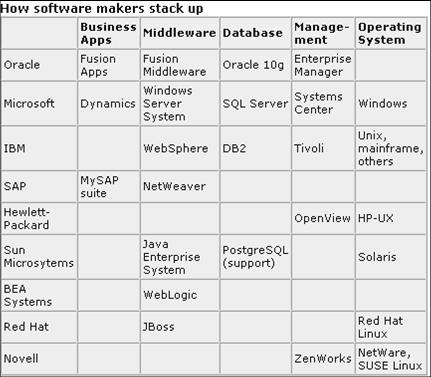
The implication is that these companies are consolidating their markets to be a one-stop shop for everything their customers want. So is software Venture Capital Investing a threatened proposition? I want to make a couple of observations regarding this:

This shift by the Majors represents the counterswing to the best-of-breed market dynamic over the past ten years. The positioning is that best-of-breed created too many data sets that are too hard to integrate, there was no composite view of the enterprise, and it is thus time for a change. There is an element of truth to this and makes sense for applications that are long-standing where process doesn't ever really change. While this may all be a nice corporate line...the best software salesmen within the Majors will regardless prey on best-of-breed features..not the "stack."

Yes...the Majors are changing their tune from best-of-breed to "we can do it all" BUT innovative, small best-of-breed companies will not be frozen to death. Business Units generally drive software selection not IT when it comes to user-facing apps. except for more mundane stuff. Business Units are not going to let IT decide what is best for business. Software innovation generally comes from small, very focused companies. So best-of-breed solutions will generally derive from some place other than the one-stop shop. Every one of the companies referenced in the table above was, at its origin, the best-of-breed for something. When they lost their capacity to either manage or spark innovation beyond their core, they started buying this innovation...it is how the software world works. I believe they could get so mired in integration (e.g. Oracle) that innovation will be further stifled.

However, one-stop shops will be able to disrupt the sales process of best-of-breed software vendors. As long as a possibility exists within the mind of the Business Unit that the one-stop-shop might have a solution...then they become the competition because they are allowed to be drawn into the sales process even though they may not have any relevant competence. BUT since they are putting themselves into position to become the monolithic data repository...then they may get into position to sell the customer that one-stop-shop should be hired to customize to the customer's needs so as to maintain system integrity. THEN...if they hear the request enough times from the market via this disguised form of market research...they can go build the software knowing there is a market for it. This potential for invasiveness does negatively impact the venture world BUT then again...it has always been there in some way shape or form.

Monday, April 3

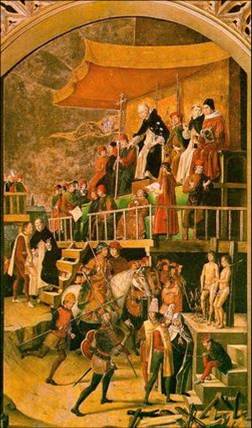
NOBODY Expects the Spanish Inquisition

Today March 28, 2006, I was thoroughly interrogated by a limited partner in SMH PEG I, L.P. (“PEG I”) (http://www.smhpeg.com/). This specific limited partner (“LP”) was not in a particularly good mood and decided to pan sear me via a very intense line of questioning. When talking to me he held in his hand our latest quarterly report on PEG I. I noticed that on his copy of the report (which I thought was pretty favorable) there where several notations in the margins, words circled, and some exclamation marks. Several of these notations were not very complimentary. This was starting to remind me of certain days during my academic career.

This LP has made a lot of money in the oil field. He is experienced. This experience is not to be taken lightly. When verbalized it can be intimidating, it is authoritative. One of the comments he made while I was on the witness stand was that none of the portfolio companies had any significant hard assets and thus no backstop for investors if things went south. The implications here may have been that our investing model was flawed – I assumed this..I didn’t ask. He seemed fairly upset that we had put him into something with no hard-asset backstop. He made an interesting point. The perspiration was starting to flow. He wanted to know exactly when the money from one of our portfolio companies was going to start flowing back to him…his RPM was increasing with each question.

I will not go into the obvious counterpoint debate against LP’s observations (i.e. all the details about why software companies can be valuable despite the absence of material hard assets or current dividends). What I will say is that this is almost EXACTLY why we are investing the way that we are. What we are doing is generally not recognizable to LP. It is not recognizable to most of the venture world. If it was… …it would be “conventional”. So I love his angst…it is based on the fact that there is no established history of energy-focused general IT companies making investors piles of money (see “What is Happening in Front of Me”, November 2005 at http://www.energyit.blogspot.com/).

This is validation to me. If there were such a history, the sector would be full of money, pre-money values of companies seeking capital would be high, talent to run these companies would be difficult to recruit and too expensive, etc. etc. Our investment thesis would sound like everyone else’s and managing PEG I would be approximately no fun whatsoever.


OK…if you’re so smart what exactly is your investment thesis? OK…I’ll lay it out:
  1. The energy sector’s production capabilities are stretched and it is going to only get worse if some form of mitigating action isn’t taken by its participants– they know this.
  2. The energy sector needs to replace manpower deficiencies with information technology – they understand this.
  3. The rest of the venture world has never really spent any time in the energy sector or in Houston, Texas - this is not a competitive market at all.
  4. There is a great opportunity to bolt together quickly an ecosystem of leadership talent.
  5. Energy sector’s spending on IT is going to take on unprecedented levels – this is happening now.
  6. Other large IT companies are going to wake up to this and find out they have to buy their way into energy sector – must be present to win in the oilfield sector.

    A really smart investor once told me..”you never make money by running with the crowd…always bet against the crowd.” I have played this in my head over and over during my career…this statement is right so many times. As a result…when people start agreeing with me en masse too soon…I get paranoid and nervous…I become uncomfortable….I start looking for an exit. But based on today’s re-creation of my own Spanish Inquisition….I am inclined to sit very still and feel much better about what we are doing.